
Epoxy Floor Repair
The kind of damage a floor shows — cracking through the coating, areas lifting away, or a worn-through section — points to different underlying causes. What the right response looks like depends on which cause is at work. Sometimes the practical answer is targeted attention to a defined area; sometimes the existing coating has to come off entirely before starting over. Determining which path makes sense requires a close look at both the existing coating and the concrete beneath.

The Short Answer
Each form of damage carries a signal about its origin. Cracking and chipping tend to begin from impact above or from movement in the concrete below. Peeling and delamination show that the bond between coating and slab has given out. Worn, dulled, or discolored areas reflect accumulated traffic and chemical contact. Because each damage pattern has a different root, each requires a different response — and finding the right one begins with an evaluation that identifies what failed, how widespread the damage is, and what the concrete underneath looks like.
Common Problems With Epoxy Floors
What a professional evaluation typically turns up across the most frequent damage patterns.
01
Cracks & Chips
A professional assessment typically encounters two distinct failure types. Impact marks — chips, gouges, surface scars — arrive from above: tools, equipment, or heavy objects making contact with the coating directly. Coating cracks, unlike those impact injuries, generally originate below the surface — settlement, load shifts, or temperature cycling in the concrete working through to the finish. When the damage is contained and the coating in the surrounding area still holds its bond, targeted repair may be a workable option. That determination comes after the contractor assesses the damage and its probable source.
02
Peeling & Delamination
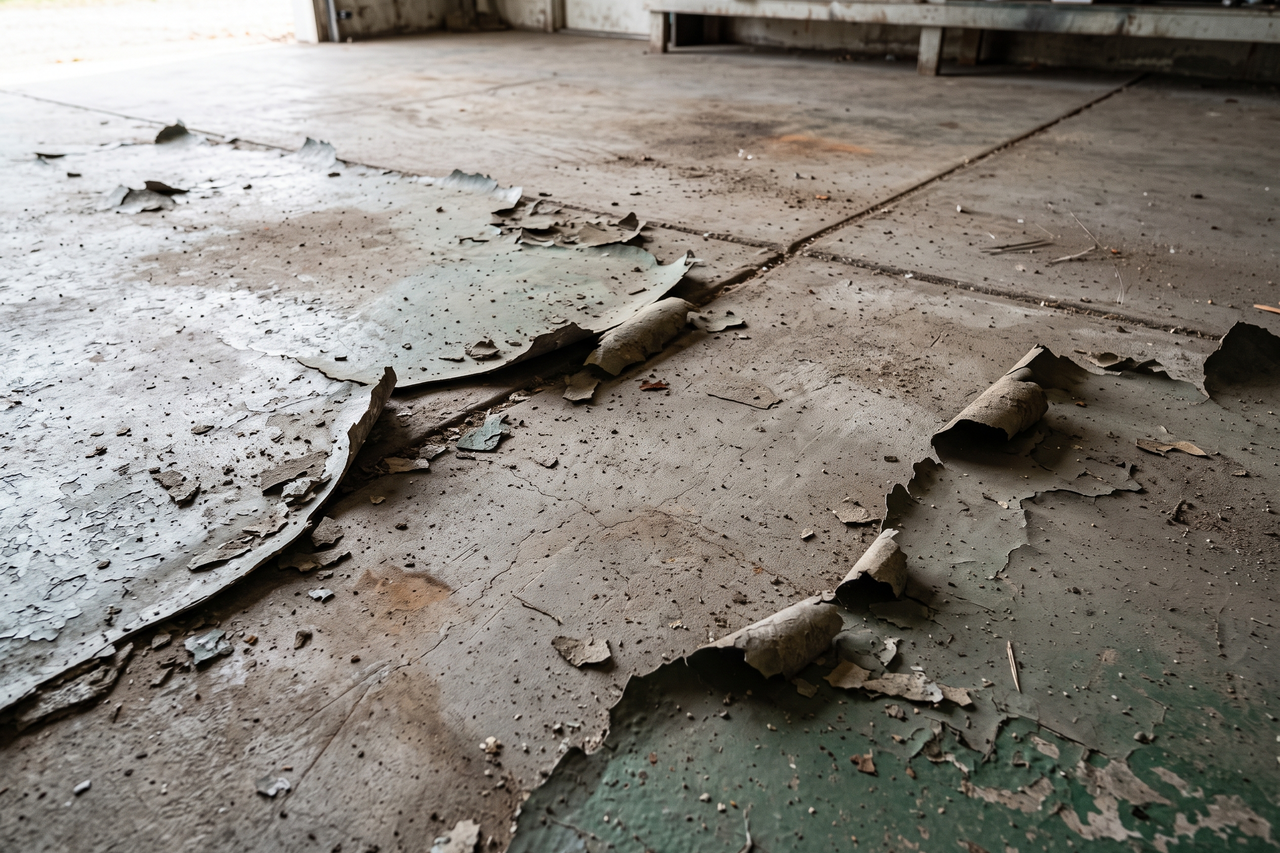
Separation that starts in one area does not tend to stay confined to it — once the coating lets go, the failure tends to spread. Peeling means the bond between coating and concrete has broken down, and identifying what broke it is central to any effective repair. Adhesion failure of this kind typically connects to the original installation: moisture in the slab that went unmeasured, a surface not opened to the profile the new product needed, or a prior coating layer that prevented the new material from reaching solid concrete below. Tracing the failure back to its source is what makes a durable repair possible.
03
Stains & Surface Wear
Dulling, scuffing, and discoloration from ongoing use and spills occupy a different category from bond failures. The coating may show surface wear while the layer underneath still adheres strongly to the concrete. When that is the case, a new topcoat applied over an intact base may be sufficient to bring the surface back. Before taking that route, the contractor verifies the adhesion quality and reviews the general state of the coating.
How Do Professionals Repair Peeling or Damaged Epoxy Floors?
The contractor’s first step is a thorough examination of the existing floor — before any product or material goes back down. The assessment determines which portions of the old coating are still securely bonded, identifies what drove the failure, and examines the concrete under the affected areas.
Loose or separated coating is removed — no new material is applied over it. A section that sounds hollow under a tap or releases with little force has already lost its bond. Applying fresh product over that section pushes the failure higher rather than resolving it. After the compromised material is stripped, the concrete surface is cleaned and profiled to give the repair material or new coating a solid anchor.
When separation has spread broadly across the floor, the evaluation may shift from spot repair to a complete recoat. The contractor assesses the full scope before making any recommendation.
Preparing the exposed concrete thoroughly after stripping is as much a part of the repair as the coating itself. The prep guide covers what that preparation work involves and why it matters to the repair’s durability.
Can an Epoxy Floor Be Repaired, or Does It Need to Be Replaced?
Both outcomes are possible. The deciding factors are how much of the existing coating still bonds firmly and what drove the failure in the first place.
Full removal is not the reflexive starting point. When a problem is bounded — a small zone of lifting, a cluster of chips, a single stable crack — addressing that section while leaving intact coating in place can be the right call. If the coating surrounding the damaged area still bonds firmly to the concrete, selective repair can add real service life to the floor.
Stripping and recoating is the appropriate response when adhesion loss covers the majority of the surface, when the moisture conditions that drove the original failure remain unresolved, or when deterioration has progressed to a point where targeted work cannot realistically address it.
Looking at a floor tells only part of the story. Physical testing — tapping, probing the bond, and examining the concrete beneath — gives the contractor a much clearer picture than a visual inspection alone. If a complete new installation turns out to be the appropriate path, our installation guide walks through that process, from opening the slab through the finished surface.
How Much Does Epoxy Floor Repair Cost?
Quoting a meaningful cost figure without seeing the floor is not possible. “Repair” covers a broad range of situations — from sealing a single hairline crack on an otherwise sound surface to stripping and recoating a slab where adhesion has failed broadly. What the work actually involves depends on the nature of the damage and how widely it has spread, how much coating must come off, the condition of the concrete below, and what preparation the project calls for.
Pricing should reflect the actual floor. A number produced without looking at the specific slab has little to offer.
What Causes Epoxy Floors to Fail, and How Can You Prevent It?
Knowing why coatings break down can be just as useful before a new installation as when a floor is already showing signs of failure. The same recurring causes account for most premature coating failures.
Improper Concrete Preparation
Preparation-related shortfalls come up consistently when coatings begin failing before expectations. Profile depth that fell short, surface contamination not cleared away, or residue from a prior coating that blocked the new product from reaching solid concrete can each prevent the coating from developing the adhesion it requires. Under those conditions, a new coating may appear sound at first and then progressively lose its grip as use builds.
Preparation deserves treatment as a full stage of the project in its own right. The prep guide covers what a thorough preparation process involves.
Excess Moisture
Moisture rising through a concrete slab is easy to overlook and hard to address once a coating is in place. When it accumulates at the boundary between slab and coating, the pressure it generates pushes against the bond from below — and the signs, which can include bubbling, blistering, or gradual lifting, often appear after the installation is done. The answer lies in measurement before the coating goes down: knowing what the slab is releasing so that product choices reflect actual conditions.
Heavy Impacts and Chemical Exposure
No coating performs equally in every environment. Hard impacts from heavy dropped objects, chemical contact from substances the product was not formulated to handle, and grinding abrasion from constant traffic can degrade even a properly applied surface over time. Matching the product to what the space will actually demand is part of getting it right.
Improper Installation or Curing
Even when preparation is done correctly, mistakes during the coating application can undermine it. Getting the mix ratio wrong, working outside the temperature or humidity conditions the product requires, rushing between coats, or poor curing conditions each represent independent paths to failure.
The installer should outline the curing schedule and describe what environmental conditions need to stay consistent before work begins. When the original failure traces to application as its source, redoing the work under controlled conditions is often the right fix. For a sense of how a well-run job unfolds, see our installation guide.
Can Garage, Basement, and Commercial Epoxy Floors Be Repaired?
Each setting raises different questions when it comes to repair. The type of damage involved and how intensively the space is used both bear on what approach fits.
Garage Floor Repair
Garage coatings face a demanding environment: vehicle weight, oil and chemical spills, temperature cycling, and contact from tools and equipment. Chips, stable cracks, and contained areas where the coating has let go are the patterns contractors encounter most often in garage assessments. If damage is confined and the coating in the surrounding area is still securely bonded to the concrete, addressing just those spots may be a cost-effective approach. When chemical breakdown or adhesion failure extends to much of the slab, stripping and recoating becomes the more likely direction — a determination the contractor reaches after reviewing the floor as a whole. Our garage coatings page covers the basics of a sound garage coating system.
Whether any part of the garage can stay accessible while work is underway is a question the project scope and the contractor’s judgment answer — worth raising when discussing the estimate.
Basement Floor Repair
Basements see moisture-related coating failures at a higher rate than most other floor types, and that pattern changes what repair must accomplish. When moisture pressure in the slab went unresolved during the original installation, running a new coating over the same unaddressed conditions reproduces the same result. The contractor reviews the coating’s condition and the slab’s moisture data before settling on a repair approach. The basement coatings page covers what to think through when planning a basement coating project from the start.
Commercial Epoxy Floor Repair
In a business environment, a failing floor goes beyond appearance — conditions that compromise the ability of people to move safely through a space, affect cleanliness, or interrupt daily operations create real concerns. When damage is localized and the surrounding coating holds firmly with the bond remaining intact, targeted repair may be practical. When bond loss is extensive, a broader scope of work is usually the more appropriate response.
Whether part of the facility can stay operational during the project is determined by the job’s scope and the contractor’s assessment of what is practical — a question worth raising when discussing the estimate. The commercial coatings page describes what commercial-scale coating work typically involves.
Frequently Asked Questions About Epoxy Floor Repair
Should you try a DIY patch kit on a peeling floor?
Patch products are sold for this purpose, but applying one without understanding why the coating peeled is unlikely to produce a lasting result. If moisture in the slab, preparation shortfalls, or mismatched products from the original job are at the root of the problem, another layer over the same conditions produces the same outcome. Addressing the root cause is what makes the difference between a fix that holds and one that fails in the same way.
When does a floor need repair versus a full replacement?
How broadly the bond has failed across the floor is the deciding factor. By tapping the existing coating and probing the bond, the contractor establishes how much is still firmly attached and how much has let go. When failure is limited and surrounded by well-bonded coating, targeted repair is often the practical path. When bond loss covers most of the surface, a full strip and recoat is generally the more reliable path than spot treatment.
How long does epoxy floor repair typically take?
How long the project takes corresponds to how much of the floor needs attention, what preparation the concrete requires, and the coating product in use. Before work starts, the contractor describes the project schedule — covering when the floor can handle foot traffic and when heavier loads are appropriate. Timing depends on floor size and condition, preparation and the coating system, and the installer explains it before work begins.
Will repaired areas look the same as the rest of the floor?
Visual consistency after repair depends on the original product used, the current state of the adjacent coating, and how large the repaired section is. Before work starts, the contractor sets realistic expectations about appearance given those specifics. When uniform appearance across the full floor matters most, recoating the entire surface generally delivers more consistent results than patching isolated sections.
Why do epoxy floors begin peeling or failing?
While moisture shows up often as a factor, it doesn’t explain every case of peeling. Preparation shortfalls on the concrete, applying product to a substrate it was not designed to bond with, errors in the mixing or application process, or curing conditions that prevented the product from hardening correctly are all independent causes. Pattern and location of the damage guide the contractor toward the most probable cause.
Do contractors offer warranties on repair work?
Warranty terms, if any, come from the contractor handling the project — this site has no role in what is covered. Ask the contractor directly what coverage applies, under what conditions, and what its terms are before work begins.
Ready to Evaluate Your Floor in Murray, KY?
Is your epoxy floor showing cracks, peeling patches, or worn-through sections? Reaching out now gets that process moving. We’ll work to connect you with an independent flooring contractor who can review the project and, if it’s a fit, prepare a customized estimate.